



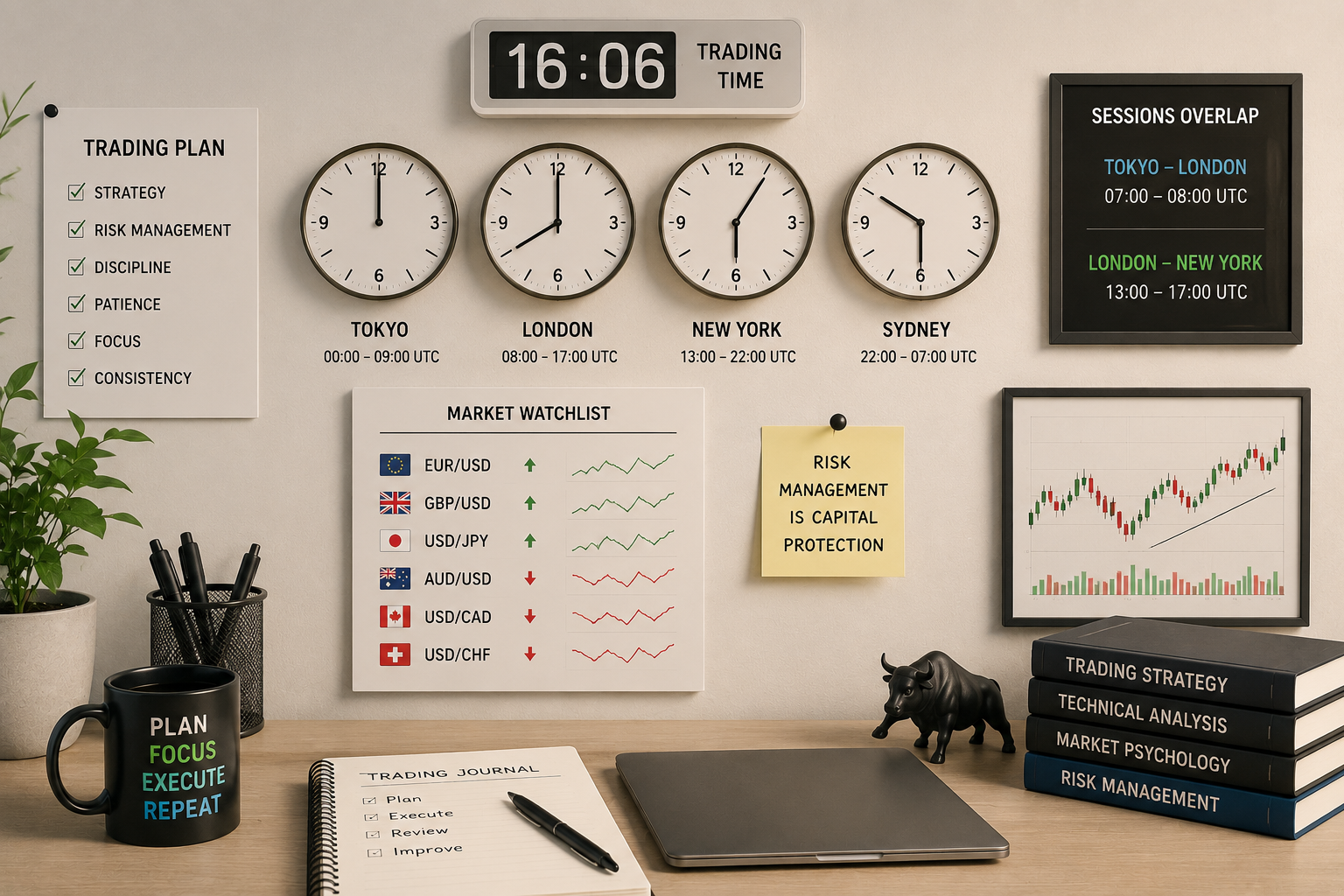
Learn how forex trading hours, market sessions, and price movements affect your trades. Discover the best time to trade forex with higher liquidity and lower spreads.
The Four Major Forex Trading Sessions and Their Key Overlap Periods
The forex market operates 24 hours a day, five days a week, making it one of the most active financial markets in the world. However, market activity isn’t constant throughout the day. Liquidity, trading volume, and price volatility increase or decrease depending on which global financial centers are open.
Understanding the four major forex trading sessions and the periods when they overlap can help traders identify the best times to trade, enjoy tighter spreads, and take advantage of stronger market movements.
Overview of the Four Forex Trading Sessions (UTC Time)
The forex market is divided into four major trading sessions, each representing a different financial hub.
| Trading Session | Opening Time (UTC) | Closing Time (UTC) |
|---|---|---|
| Sydney Session | 22:00 | 07:00 |
| Tokyo Session | 00:00 | 09:00 |
| London Session | 08:00 | 17:00 |
| New York Session | 13:00 | 22:00 |
All times above are based on Coordinated Universal Time (UTC).
The trading week officially begins when the Sydney session opens at 22:00 UTC on Sunday and ends when the New York session closes at 22:00 UTC on Friday.
Keep in mind that many forex brokers display trading hours using local server time such as EET (UTC+2/UTC+3) or EST (UTC-5/UTC-4). Always verify your platform’s server time before planning your trading schedule.
The Two Most Important Forex Session Overlaps
Although the forex market remains open around the clock, the periods when two major trading sessions overlap usually provide the highest trading opportunities.
London–New York Overlap (13:00–17:00 UTC)
The overlap between the London and New York sessions is widely regarded as the busiest and most liquid trading period of the day.
Since London is the world’s largest forex trading center and New York ranks second, this four-hour window attracts the highest trading volume. As a result, popular currency pairs such as EUR/USD, GBP/USD, and USD/JPY often experience their lowest spreads and strongest price movements.
Many breakout strategies, trend-following setups, and intraday trading opportunities occur during this period because institutional traders from both Europe and North America are actively participating in the market.
Tokyo–London Overlap (07:00–08:00 UTC)
The overlap between the Tokyo and London sessions lasts only one hour but still creates useful trading opportunities, especially for traders focusing on Japanese Yen and Asia-Pacific currency pairs.
Pairs like AUD/JPY, GBP/JPY, and USD/JPY may experience increased activity as European traders begin entering the market while Asian traders complete their trading day.
Compared with the London–New York overlap, volatility is generally lower during this period. However, sudden reversals and breakout moves can occur when fresh European order flow enters markets that were relatively quiet during Asian trading hours.
Daylight Saving Time (DST): Why Session Times Can Change
One factor many beginners overlook is Daylight Saving Time (DST).
Every year, the United States and Europe switch to daylight saving on different dates. During these transition weeks, the overlap between London and New York temporarily changes.
For example:
- During March, the overlap temporarily shifts from 13:00–17:00 UTC to 12:00–16:00 UTC.
- In November, the opposite adjustment occurs before both regions return to their regular schedule.
If your broker’s trading platform uses EET, EST, or another local timezone, session opening times may shift by one hour after each DST change.
Many traders miss the most active trading window simply because they continue following their old schedule. Checking your broker’s server clock after every daylight saving adjustment can help you avoid this common mistake.
How to Match Your Forex Trading Strategy with the Right Trading Session
There is no single “best time” to trade forex. The ideal trading session depends entirely on the strategy you use. Every trading style performs differently based on market liquidity, volatility, and trading volume.
Many beginners make the mistake of using fast-paced strategies during quiet market hours or entering long-term trades when liquidity is extremely low. Matching your strategy with the appropriate forex session can significantly improve execution quality and overall trading performance.
Scalping Strategy: Best During the London–New York Overlap
Scalping is a fast trading style where positions are opened and closed within seconds or a few minutes. Because of this, scalpers require extremely tight spreads, fast execution, and continuous market activity.
The London–New York overlap (12:00–16:00 GMT) provides the perfect environment for scalpers. During these hours, major currency pairs like EUR/USD and GBP/USD usually trade with the lowest spreads and the highest liquidity.
Institutional traders and banks are highly active during this period, reducing slippage and creating frequent short-term trading opportunities.
On the other hand, the Asian session generally offers lower volatility and wider spreads, making it less suitable for scalping strategies.
Breakout Trading: Trade the London Open After the Asian Range
Breakout traders often focus on price consolidation during the Asian trading session (00:00–09:00 GMT).
Since market movement is usually limited during Asian hours, a well-defined trading range often forms. When the London session begins, trading volume increases sharply, providing the momentum needed for price to break out of that range.
A confirmed breakout above the Asian session high—or below the session low—combined with strong London volume often produces reliable trading opportunities.
Many experienced traders place pending orders just outside the Asian range before London opens to capture these breakout moves.
Swing Trading: Enter During High-Liquidity Sessions
Swing traders usually keep positions open for several days or even weeks. Because of the longer holding period, choosing the exact session is less important than it is for scalpers.
However, opening new positions during highly liquid periods—such as the London open or New York open—usually results in better execution, tighter spreads, and less market noise.
Avoid opening swing trades during quiet periods like the late New York session on Friday or the Asian afternoon unless you intentionally want lower volatility.
News Trading: Stay Ready Before and After Major Events
Economic news releases can create some of the largest price movements in the forex market.
If your strategy focuses on trading news events, it’s recommended to prepare at least 30 minutes before the scheduled announcement and remain focused for 60 minutes afterward.
This time covers market positioning before the release, the initial volatility after the announcement, and the possible continuation or reversal that often follows.
Entering the market too late usually means the best trading opportunity has already passed.
Position Trading: Use Quiet Sessions for Better Entries
Position traders typically hold trades for several weeks or even months.
Because they are less concerned with short-term price fluctuations, they often use lower-liquidity sessions—such as the Asian afternoon or the New York session close on Friday—to enter trades.
Although spreads may be slightly wider during these periods, there is generally less market noise and fewer aggressive institutional orders, allowing for more controlled entries.
Strategy-to-Session Quick Reference
| Trading Strategy | Recommended Trading Session | Typical Holding Time |
|---|---|---|
| Scalping | London–New York Overlap | Seconds to Minutes |
| Breakout Trading | London Open After Asian Range | Minutes to Hours |
| Swing Trading | High-Liquidity Sessions | Days to Weeks |
| News Trading | 30 Minutes Before & 60 Minutes After News | Minutes to Hours |
| Position Trading | Low-Liquidity Sessions | Weeks to Months |
Ultimately, the best trading session is the one that matches your trading style, preferred holding period, and liquidity requirements.
The Hidden Cost of Trading Outside Peak Forex Hours
Most traders concentrate on finding the best time to trade, but very few consider the extra costs of trading when market activity is low.
Lower liquidity affects more than just price movement—it can increase spreads, create slippage, and reduce overall trade efficiency.
Spread Widening: The Hidden Trading Expense
When market participation is high, liquidity providers can offer tighter bid-ask spreads.
For example, during the London–New York overlap (12:00–16:00 UTC), EUR/USD spreads on raw-spread accounts often remain around 0.2 pips.
During the Sydney session (22:00–00:00 UTC), those same spreads may widen to 1.0–1.5 pips, increasing trading costs several times over.
Currency pairs like GBP/JPY and USD/MXN often experience even larger spread increases.
This isn’t simply a broker charging more—it reflects the increased cost of providing liquidity in a thinner market.
Session Opening Gaps and Their Risks
The forex market officially opens on Sunday at 22:00 UTC, and this period is well known for sudden price gaps.
Because the market remains closed throughout the weekend, major political events, economic news, natural disasters, or central bank announcements can significantly impact prices before trading resumes.
As a result, stop-loss orders may be executed much further from their intended levels.
Gap risk isn’t limited to Sunday. Session openings in Tokyo, Sydney, and London can also produce short-term price gaps during the first few minutes as new trading orders enter the market.
Stop-Loss Hunting in Low-Liquidity Markets
Lower trading volume means smaller orders can create larger price movements.
A market order that barely affects EUR/USD during the London session may move the same pair several pips during quiet trading hours.
This often causes price to briefly trigger stop-loss orders placed near psychological levels or recent highs and lows before reversing back in the opposite direction.
In most cases, this isn’t market manipulation—it’s simply the result of thin liquidity and normal order-book behavior.
Broker Changes During Quiet Market Hours
Many forex brokers automatically adjust trading conditions when liquidity decreases.
Common adjustments include:
- Wider spreads during quiet sessions.
- Higher margin requirements on selected instruments.
- Temporary increases in trading costs around session openings.
These changes are usually listed under your broker’s Trading Hours or Product Specifications, making it worthwhile to review them regularly.
Measuring the Real Cost of Low-LLiquidity Trading
Imagine a scalper completing 20 round-turn trades in one day.
During peak trading hours with spreads averaging 0.2 pips, the total daily spread cost would be around 4 pips.
Trading the same strategy during slower sessions with spreads near 1.2 pips increases that cost to approximately 24 pips.
Over a standard trading month, this difference can accumulate into hundreds of unnecessary pips, reducing profitability without changing the strategy itself.
Even the strongest trading setup becomes less profitable when trading costs increase dramatically.
Weekend Gaps, Monday Market Opens, and Friday Closing Behavior
Sunday Market Open: Thin Liquidity and Price Gaps
The forex trading week begins on Sunday at 22:00 UTC, but the market rarely opens exactly where it closed on Friday.
Weekend news, geopolitical developments, central bank decisions, and unexpected economic events often cause prices to gap higher or lower.
Since liquidity is limited during the first 30 to 60 minutes, spreads are wider and slippage becomes more common.
Traders choosing to trade immediately after the market opens should consider reducing position sizes and preparing for greater volatility.
Friday New York Close: Position Closing and Increased Volatility
As the trading week comes to an end, many institutional traders close positions to avoid weekend uncertainty.
This reduces market liquidity while increasing the influence of algorithms and remaining market participants.
During the final trading hour, spreads often widen significantly, and false breakouts around important support and resistance levels become more frequent.
Holding positions into the weekend means accepting the possibility of unpredictable market gaps.
Tokyo Open: Setting the Direction for the Asian Session
The Tokyo session begins at 00:00 UTC and frequently establishes the day’s initial trading range.
Many intraday traders monitor the first 30-minute candle closely.
A breakout above or below this early range may indicate trend continuation, while a reversal back through the opening price often signals weakening momentum.
The Tokyo session’s opening range is commonly used as support and resistance throughout the Asian trading session.
Weekend Holding Risk and Daylight Saving Time (DST)
Keeping positions open over the weekend always carries gap risk.
Unexpected news can cause the market to reopen dozens—or even hundreds—of pips away from Friday’s closing price.
Traders who decide to hold weekend positions should have a well-defined risk management plan, including appropriate stop-loss placement or hedging strategies.
Daylight Saving Time (DST) also changes forex session schedules twice each year.
During March, the New York session temporarily begins one hour earlier in UTC, while November returns it to the regular schedule.
Failing to adjust your trading timetable after these changes may cause you to miss the most active trading sessions or accidentally trade during low-liquidity periods.
How to Create a Personal Forex Trading Schedule Around Market Sessions
Understanding forex trading sessions is only the first step. The real advantage comes from building a consistent trading routine that matches your local time, daily schedule, and preferred trading style.
Instead of trading randomly throughout the day, create a structured plan that helps you focus on the hours when your chosen strategy performs best.
Step 1: Convert Forex Session Times to Your Local Time Zone
Start by identifying your local UTC offset. For example, traders in different countries may use UTC+2, UTC+5, UTC-5, or another time zone depending on their location and daylight saving adjustments.
Once you know your offset, mark the opening times of the four major forex trading sessions on your calendar:
- Tokyo Session: 00:00 UTC
- London Session: 08:00 UTC
- New York Session: 13:00 UTC
- Sydney Session: 22:00 UTC (or 23:00 UTC during winter in some regions)
After marking these sessions, identify the two most important overlap periods:
- Tokyo–London Overlap: 08:00–09:00 UTC
- London–New York Overlap: 13:00–17:00 UTC
Among these, the London–New York overlap usually provides the highest trading volume and the best liquidity, making it the preferred trading window for many forex traders.
Step 2: Organize Your Daily Trading Routine
A well-planned trading schedule improves discipline and reduces emotional decision-making.
Reserve the busiest market hours for activities such as:
- Opening new positions
- Managing existing trades
- Adjusting stop-loss levels
- Taking profits
Use quieter trading sessions, particularly the Asian session, for productive tasks like:
- Reviewing previous trades
- Performing chart analysis
- Backtesting trading strategies
- Updating your trading journal
- Planning trades for the next session
Unless your strategy specifically targets low-volume markets, avoid placing unnecessary trades during periods of limited liquidity.
Step 3: Use Trading Alerts Instead of Watching Charts All Day
Successful traders don’t spend every minute staring at price charts.
Instead, use an economic calendar that displays events in UTC and set alerts for:
- Major forex session openings
- High-impact economic news
- Central bank interest rate decisions
- Inflation reports (CPI)
- Employment data such as Non-Farm Payrolls (NFP)
Price alerts allow you to focus on trading only when market conditions match your strategy, helping you avoid unnecessary screen time and emotional trading.
Step 4: Adjust Your Schedule to Your Local Time Zone
Every trader lives in a different time zone, so your ideal trading hours may not match someone else’s routine.
For example:
- A trader in Bangkok (UTC+7) can comfortably trade the London session during the afternoon and continue into the London–New York overlap during the evening.
- A trader in Los Angeles (UTC-7) may find the Tokyo session more convenient because it begins during local evening hours, making pairs like USD/JPY and AUD/USD easier to trade.
The goal isn’t to trade every session—it is to focus on the session that fits your daily lifestyle and offers the best opportunities for the currency pairs you trade most often.
Weekly Forex Trading Schedule Template
| Time (UTC) | Recommended Activity | Currency Pairs to Watch |
|---|---|---|
| 22:00–08:00 | Market analysis, journaling, backtesting | AUD/USD, NZD/USD, USD/JPY |
| 08:00–09:00 | Tokyo–London overlap, light scalping | USD/JPY, EUR/JPY, GBP/JPY |
| 09:00–13:00 | London session, trend-following and breakout trades | EUR/USD, GBP/USD, USD/CHF |
| 13:00–17:00 | London–New York overlap, primary trading window | All major pairs, EUR/JPY, GBP/JPY |
| 17:00–22:00 | Review trades, manage positions, prepare next day’s watchlist | Market review and planning |
Copy this schedule into your preferred calendar or trading planner and adjust each time block according to your local timezone.
Follow the same routine consistently for at least two weeks. After reviewing your results, make small improvements based on when you experience the best market conditions and trading performance.
Frequently Asked Questions (FAQ)
What Are the Four Major Forex Trading Sessions and Their UTC Times?
The forex market is divided into four major trading sessions:
- Sydney Session: 22:00–07:00 UTC
- Tokyo Session: 00:00–09:00 UTC
- London Session: 08:00–17:00 UTC
- New York Session: 13:00–22:00 UTC
Each session represents the business hours of a major financial center. The busiest period occurs when the London and New York sessions overlap, creating the highest trading volume and market liquidity.
When Is the Best Time to Trade Forex for Lower Spreads?
The London–New York overlap (13:00–17:00 UTC) is generally considered the best time to trade because liquidity is at its highest.
During this period, popular currency pairs such as EUR/USD and GBP/USD often experience the narrowest spreads, faster execution speeds, and stronger price movements.
Trading during quieter sessions may result in wider spreads and lower market activity.
Which Currency Pairs Are Most Active During the London–New York Overlap?
Several major currency pairs experience increased volatility while both London and New York markets are open.
Some of the most actively traded pairs include:
- EUR/USD
- GBP/USD
- USD/JPY
- USD/CAD
These pairs often react to economic reports from both Europe and North America, creating strong intraday trading opportunities.
Why Do Forex Price Gaps Occur on Sunday?
The forex market closes on Friday evening and reopens on Sunday night.
During the weekend, important global events may occur while trading remains closed. As a result, prices sometimes reopen significantly higher or lower than Friday’s closing price.
To reduce weekend gap risk, traders often:
- Lower their position sizes before the weekend
- Avoid excessive leverage
- Consider closing short-term trades before the market closes
- Use pending orders carefully when the market reopens
How Does Daylight Saving Time Affect Forex Trading Sessions?
Daylight Saving Time (DST) changes can temporarily shift forex trading hours because countries adjust their clocks on different dates.
For a few weeks each year, major sessions such as London and New York may open one hour earlier or later relative to UTC.
To avoid missing important trading opportunities, always check your broker’s updated trading schedule whenever daylight saving changes occur.
